The Ultimate Guide to Clean Room Systems Everything You Need to Know
The Ultimate Guide to Clean Room Systems: Everything You Need to Know
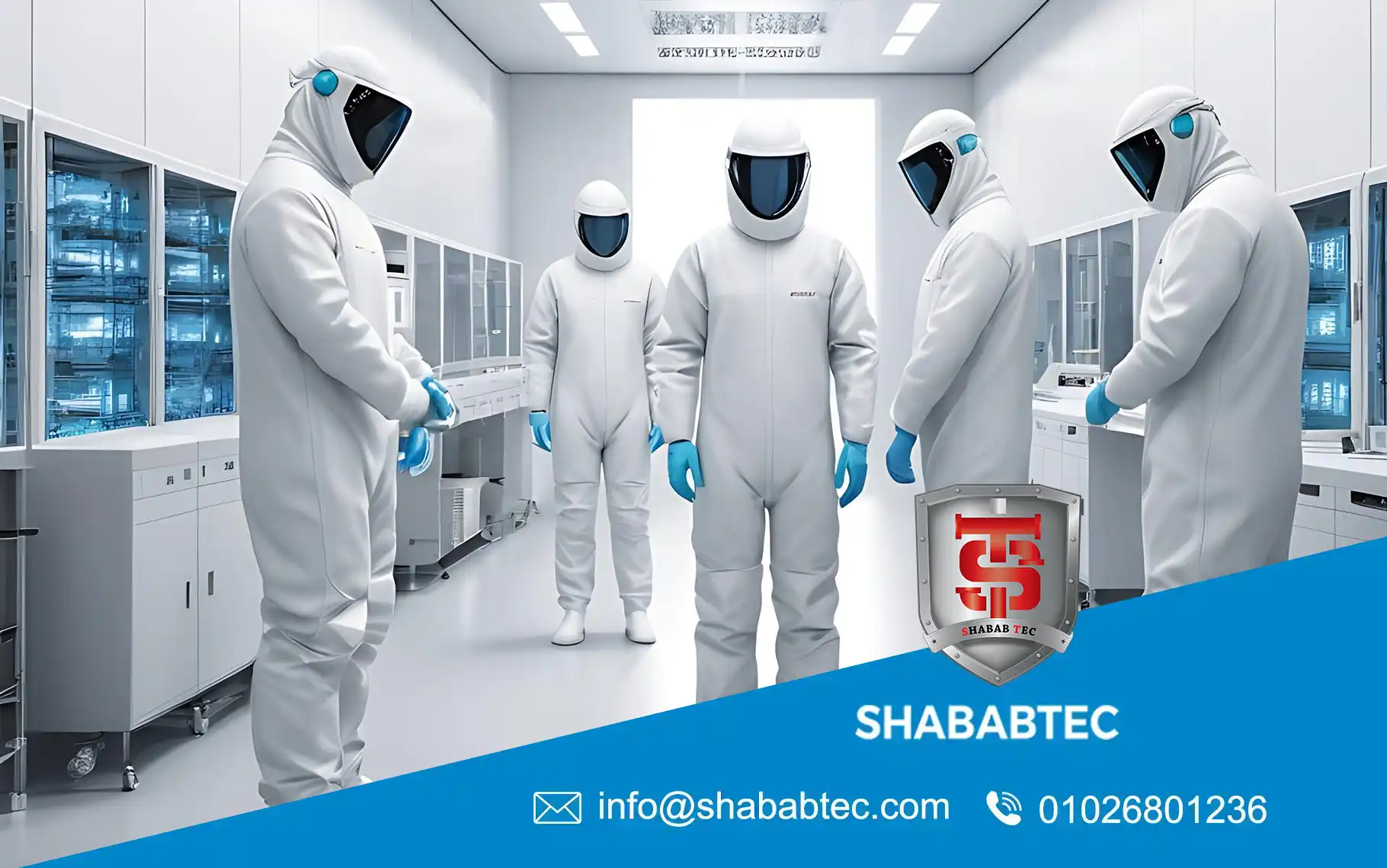
In industries where contamination control directly impacts product quality, human safety, and regulatory compliance, clean room systems have become a fundamental engineering solution. Pharmaceutical manufacturing facilities, semiconductor production plants, biotechnology laboratories, aerospace assembly lines, and even data recovery environments all depend on highly controlled spaces to maintain operational excellence.
A modern clean room system is far more than just an enclosed environment. It is a fully integrated infrastructure designed to regulate airborne particles, airflow patterns, pressure differentials, and hygiene standards. Companies operating in regulated industries require environments that comply with ISO standards, GMP guidelines, and strict quality assurance frameworks.
Shababtec
This comprehensive guide explains everything you need to know about clean room systems — including clean room classification standards, modular cleanroom technologies, cleanroom components, engineering principles, and key industry applications.
What is a Clean Room System? A Simple Definition
A clean room system is a controlled environment where the concentration of airborne particles, dust, microbes, and chemical vapors is regulated within defined limits. Unlike traditional rooms, cleanrooms are designed using specialized construction materials, advanced HVAC filtration systems, and strict operational protocols to maintain cleanliness levels required by sensitive processes.
Many people ask: What is a cleanroom system? Simply put, it is an integrated engineering solution combining architecture, airflow control, filtration technology, and contamination management strategies into one cohesive environment.
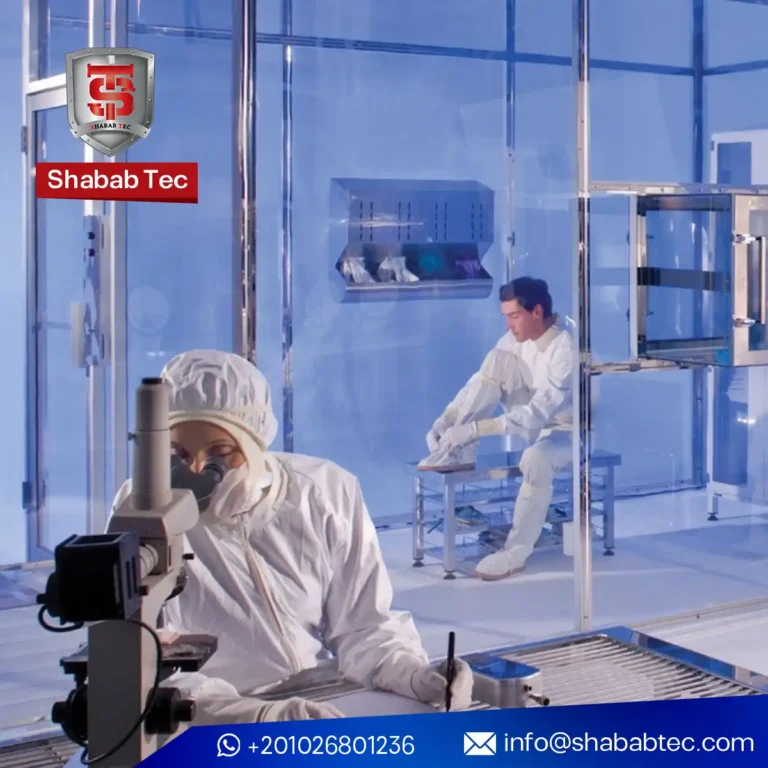
Clean rooms are used in industries where even microscopic contamination can cause product failure or safety risks. Common uses include pharmaceutical drug production, semiconductor fabrication, medical device manufacturing, laboratory research, and data recovery operations. When asking what are clean rooms used for, the answer lies in protecting processes that demand ultra-clean conditions.
A complete cleanroom system typically includes modular partition walls, clean room ceilings, air filtration units, controlled entry systems, pass boxes, and airflow management equipment. Each component works together to control the introduction, generation, and retention of particles inside the space.
Understanding Clean Room Classification: ISO, Federal Standards, and GMP
Clean room classification is essential because it defines how clean an environment must be based on the number of airborne particles allowed within a cubic meter of air. Engineers rely on internationally recognized classification systems to ensure compliance with industry requirements and to match cleanliness levels with specific applications.
ISO 14644-1: The Global Standard
The most widely used classification framework today is ISO 14644-1. This international standard ranks cleanrooms from ISO 1 (extremely clean) to ISO 9 (less strict environments). The classification depends on particle count measurements, which determine whether a cleanroom is suitable for pharmaceutical production, semiconductor assembly, or general industrial use.
Below is a simplified clean room classification chart showing common ISO levels and their applications:
Many engineers ask: Is ISO 7 better than ISO 5? The answer depends on application requirements rather than superiority. ISO 5 environments allow significantly fewer particles compared to ISO 7, making them suitable for sterile pharmaceutical operations, while ISO 7 is often adequate for less critical manufacturing processes.
Old Federal Standard 209E (FS 209E)
Before ISO standards became dominant, industries relied on Federal Standard 209E classifications such as Class 10 clean room and Class 100,000 clean room. Although officially withdrawn, many engineers still reference these classes today. For example, Class 100 corresponds approximately to ISO 5, while Class 100,000 aligns closely with ISO 8 environments.
GMP Classification for Pharmaceuticals
Pharmaceutical facilities follow a different approach known as GMP classification. Instead of ISO numbers, cleanrooms are categorized into Grades A, B, C, and D depending on sterility requirements and risk levels. Grade A represents the highest cleanliness level used for aseptic filling operations, while Grade D environments are suitable for less critical stages of drug manufacturing.
Understanding pharmaceutical clean room classification and clean room classification ABCD standards is essential for companies operating under regulatory authorities, as these grades determine airflow design, filtration performance, and operational procedures.
How Does a Cleanroom Work? The Core Components
To understand how does a cleanroom work, it is important to recognize that contamination control depends on managing three main factors: controlling particle entry, limiting particle generation inside the space, and removing contaminants efficiently through airflow and filtration. A clean room system achieves this through a combination of engineering design, specialized materials, and strict operational practices.
Airflow patterns, pressure differentials, and high-efficiency filtration create an environment where particles are continuously captured and removed. The architecture itself — including walls, ceilings, and access systems — is designed to minimize dust accumulation and simplify cleaning procedures.
The HVAC and Air Filtration System (HEPA/ULPA Filters)
The HVAC system is often described as the lungs of a cleanroom. It regulates temperature, humidity, airflow velocity, and air cleanliness levels. High-Efficiency Particulate Air (HEPA) filters and Ultra-Low Particulate Air (ULPA) filters capture microscopic particles before air enters the controlled environment.
In advanced modular cleanroom system designs, airflow is carefully engineered to support laminar flow patterns that reduce turbulence and prevent contamination from settling on sensitive surfaces. Proper HVAC integration ensures compliance with ISO standards and pharmaceutical GMP requirements.
Clean Room Architecture: Walls, Ceilings, and Floors
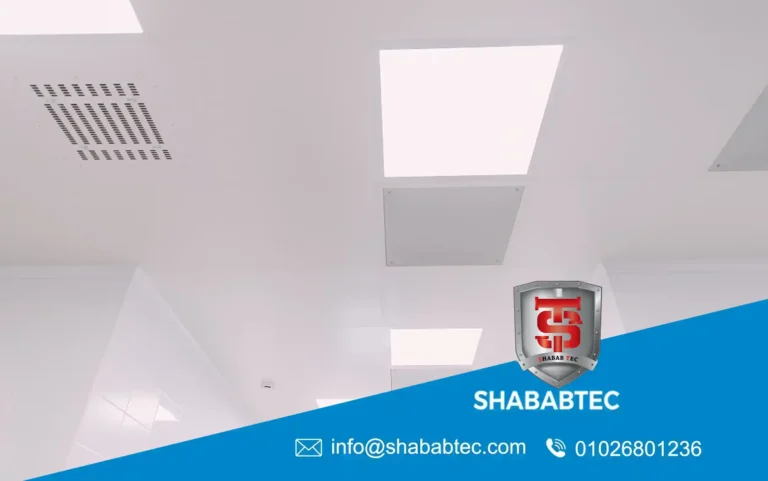
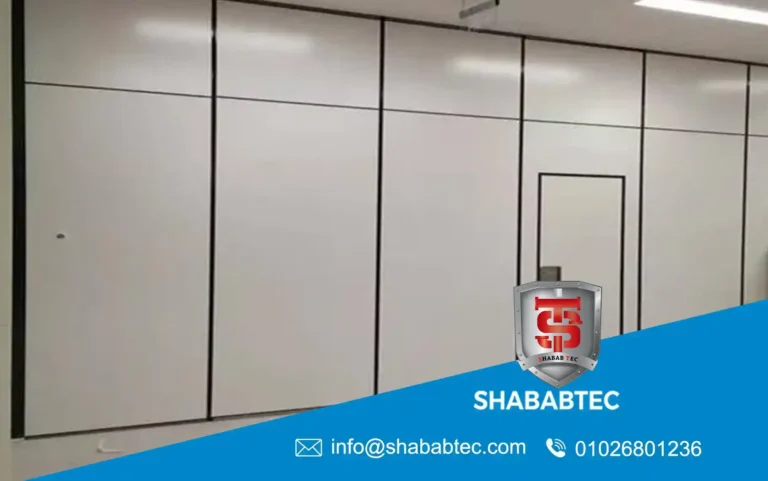
Cleanroom architecture differs significantly from traditional construction. Surfaces must be non-shedding, chemically resistant, and easy to sanitize. Modular partition walls and ceiling systems create a sealed envelope that prevents contamination while supporting airflow management.
Modern modular cleanroom solutions use flush-mounted panels that eliminate gaps or ledges where particles could accumulate. These systems also allow rapid installation and future expansion without major structural modifications. Shababtec Clean room laboratory Factory specializes in engineering partition walls and ceiling systems specifically designed for controlled environments.
Entry and Exit Systems: Air Showers & Pass Boxes
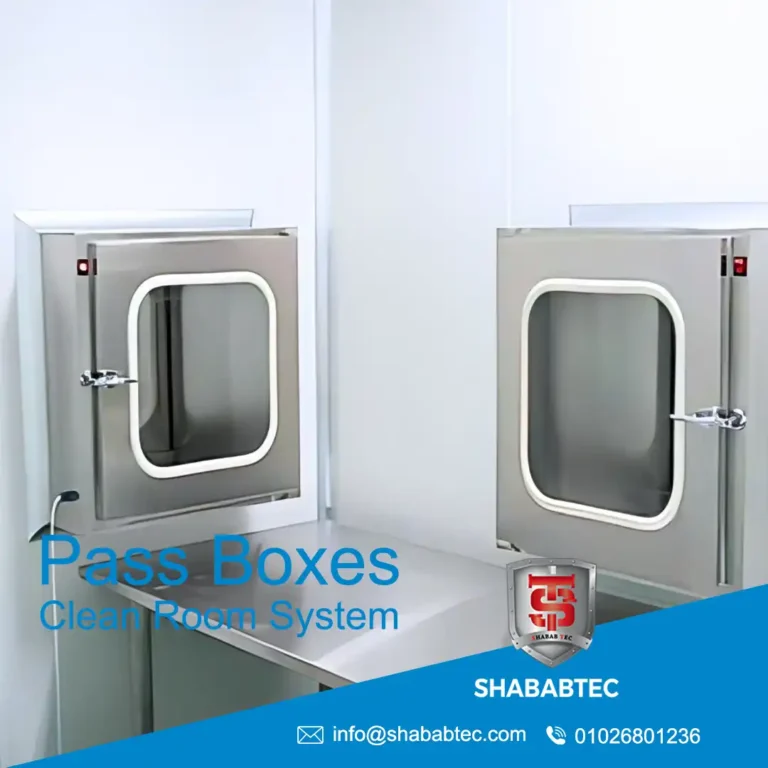
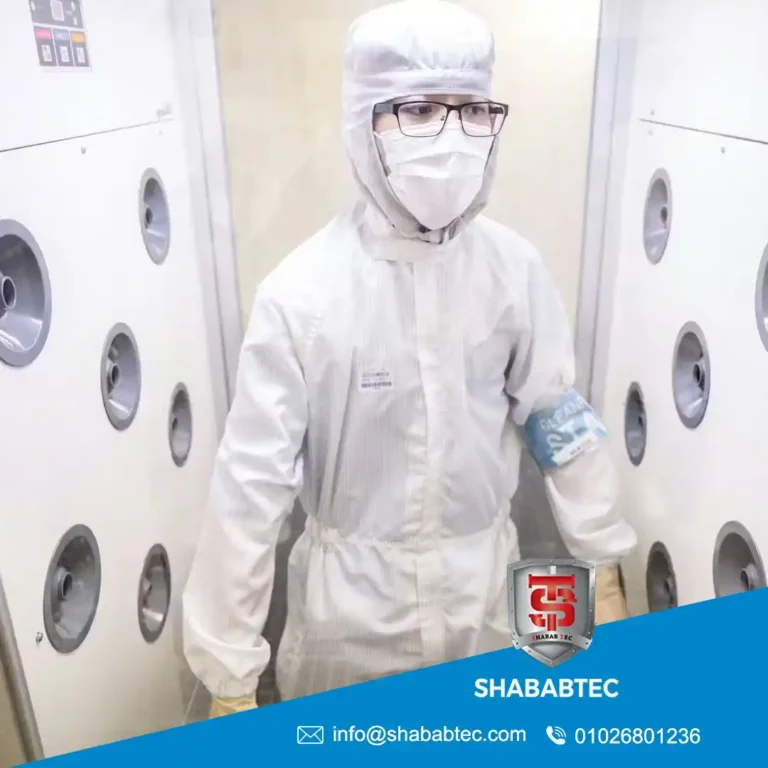
Personnel and material transfer points represent the highest contamination risk within any clean room system. Air showers remove particles from clothing using high-velocity filtered air, while pass boxes allow materials to move between zones without disrupting pressure balance.
By integrating air showers, pass boxes, and controlled door systems, cleanroom facilities maintain strict separation between clean and non-clean areas. These components play a vital role in pharmaceutical manufacturing, semiconductor production, and laboratory environments where contamination control is critical.
Types of Clean Rooms: Modular vs. Traditional
When planning a cleanroom project, one of the most important decisions involves choosing between modular cleanroom systems and traditional stick-built construction. Each approach offers different advantages depending on project timelines, flexibility requirements, and budget considerations.

Modular Cleanroom Systems
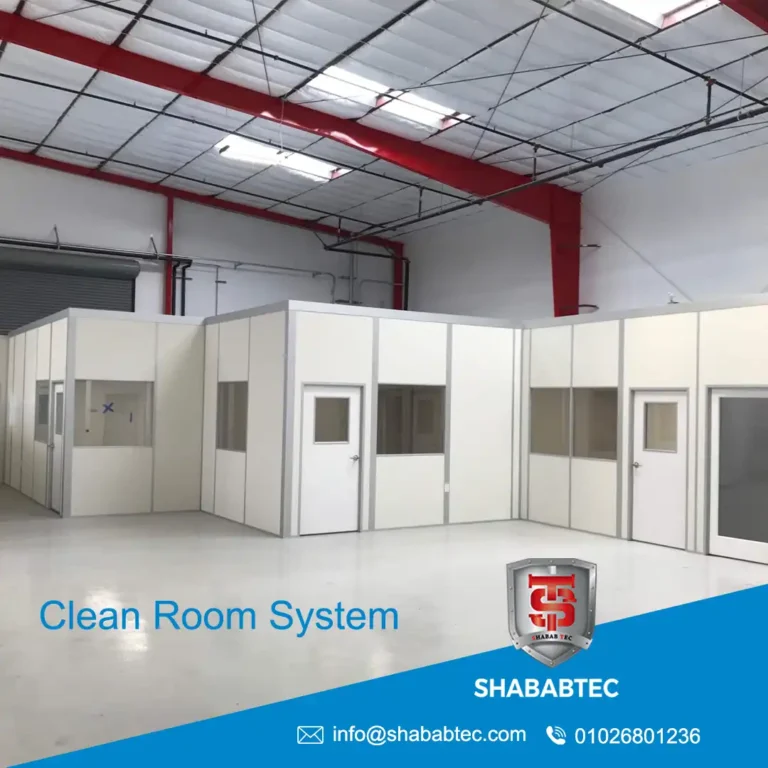
A modular cleanroom system uses prefabricated panels, aluminum frames, and integrated architectural components to create a controlled environment quickly and efficiently. These systems are highly scalable and can be expanded, relocated, or reconfigured as operational needs evolve.
Modular cleanrooms offer faster installation, reduced downtime, and improved cost efficiency compared to traditional construction methods. Shababtec’s modular cleanroom solutions are engineered to meet ISO standards while providing flexibility for pharmaceutical, semiconductor, and medical applications.
- Rapid installation with minimal disruption
- Factory-engineered precision components
- Flexible expansion and reconfiguration
- Cost-effective long-term performance
Traditional (Stick-Built) Clean Rooms
Traditional clean rooms are constructed directly within a building using conventional construction techniques. While they may be suitable for permanent installations or highly customized architectural layouts, they often require longer construction times and offer less flexibility for future upgrades.
Many modern facilities prefer modul
Key Applications of Clean Room Technology
Clean room systems are used across a wide range of industries where environmental control directly impacts product performance, safety, and reliability. From pharmaceutical clean room classification environments to advanced semiconductor production, each application requires specific airflow design, cleanliness levels, and architectural components.
Semiconductor and Electronics Manufacturing
In semiconductor clean room environments, even microscopic dust particles can damage microchips or disrupt sensitive electronic assemblies. Cleanrooms used in electronics manufacturing often operate at extremely high cleanliness levels such as ISO 5 or even ISO 1 clean room classifications for advanced research and fabrication processes.
Controlled airflow, anti-static surfaces, and ultra-efficient filtration systems ensure that delicate components remain free from contamination during production. These environments play a critical role in maintaining yield rates and ensuring product reliability.
Pharmaceutical and Biotechnology
Pharmaceutical cleanrooms are designed to maintain sterile conditions required for drug manufacturing, vaccine production, and biotechnology research. Clean room classification ABCD standards defined by GMP guidelines determine how different areas within a facility must be designed and operated.
Grade A and B areas are typically used for aseptic filling processes, while Grade C and D zones support preparation and packaging activities. Proper airflow control and pressure management ensure compliance with international regulatory standards.
Aerospace and Defense
Aerospace cleanrooms are used for assembling sensitive optical instruments, satellites, and precision electronic systems. Contamination can compromise performance or lead to mission failure, making controlled environments essential during manufacturing and testing stages.
Data Centers and Data Recovery
Many people ask what is clean room in data environments. Specialized cleanrooms are used for hard drive repair and data recovery processes where dust particles could permanently damage storage media. These facilities maintain strict cleanliness levels to protect sensitive hardware components during inspection and repair.
Frequently Asked Questions (FAQ) about Clean Rooms
What is the difference between ISO 7 and ISO 5?
ISO 5 cleanroom standards allow significantly fewer particles compared to ISO 7 environments. ISO 5 is typically used for sterile pharmaceutical processes, while ISO 7 clean rooms are suitable for less critical manufacturing operations. The choice depends on the application rather than which level is considered “better.”
How much does a clean room cost?
The cost of a clean room system varies depending on classification level, size, HVAC requirements, and architectural components. Modular cleanroom systems often provide a more cost-effective solution due to faster installation and scalable design. Contact Shababtec for a customized project quotation.
What is a Class 100,000 clean room?
Class 100,000 clean room refers to the older Federal Standard 209E classification and is roughly equivalent to an ISO 8 cleanroom. These environments are commonly used in electronics assembly, packaging operations, and industrial manufacturing processes.
Can you build a modular cleanroom system in an existing facility?
Yes. One of the primary advantages of modular cleanroom design is the ability to install systems within existing buildings with minimal disruption. Modular panels allow flexible expansion and fast construction timelines.
Choose Shababtec for Your Next Clean Room Project
Selecting the right partner for designing and building a clean room system is a critical decision that directly affects long-term performance, regulatory compliance, and operational efficiency. Shababtec combines engineering expertise, local manufacturing capabilities, and international cleanroom standards to deliver reliable turnkey clean room solutions tailored to each industry.
With extensive experience in modular cleanroom system design, Shababtec Clean room laboratory Factory supports projects ranging from ISO 1 clean room environments for advanced semiconductor applications to ISO 8 and Class 100,000 clean room installations used in industrial manufacturing and packaging facilities. Every solution is engineered to align with ISO standards, pharmaceutical clean room classification requirements, and modern contamination control practices.
Why Companies Trust Shababtec Clean Room Systems
Shababtec focuses on delivering integrated clean room solutions that combine architectural precision, airflow engineering, and durable construction materials. From initial consultation to final commissioning, each project follows a structured process designed to reduce risks and ensure compliance with international regulations.
- Complete turnkey clean room system solutions
- Expertise in modular cleanroom and traditional construction approaches
- High-quality partition walls, ceilings, doors, and airflow systems
- Custom engineering based on ISO and GMP classifications
- Fast installation timelines with minimal operational disruption
- Scalable designs suitable for future expansion
By integrating cleanroom components such as modular wall systems, hidden suspension ceilings, air showers, pass boxes, and controlled access doors, Shababtec creates environments that maintain stable airflow, pressure balance, and hygiene performance over time.
Turnkey Clean Room Solutions from Concept to Commissioning
Shababtec operates as a manufacturer, supplier, and turnkey contractor, ensuring full control over quality and project execution. The turnkey approach provides clients with a single point of responsibility, reducing coordination challenges between multiple vendors.
Industries Served by Shababtec Clean Room Systems
Shababtec cleanroom solutions are engineered to support multiple industries where contamination control is essential. Each project is customized according to operational workflows, regulatory requirements, and cleanliness classifications.
- Pharmaceutical manufacturing and biotechnology laboratories
- Semiconductor clean room and electronics production
- Hospitals and medical research facilities
- Food and beverage processing plants
- Aerospace and precision engineering sectors
- Data recovery and controlled IT environments
Start Your Clean Room Project Today
Whether you are planning a new modular cleanroom system or upgrading an existing facility, Shababtec delivers comprehensive solutions designed to meet international ISO standards and GMP requirements. From clean room classification planning to architectural integration and airflow optimization, every system is engineered to achieve long-term performance and reliability.
Contact Shababtec today to discuss your project requirements, request a customized quotation, and discover how advanced clean room systems can enhance your operational efficiency across pharmaceutical, semiconductor, medical, and industrial applications.