Clean Room Ceiling System Design
A clean room ceiling is not a decorative finish—it is a critical engineered surface that supports airflow behavior,
filtration integration (HEPA), lighting, utilities, and long-term cleanability.
In ISO-classified and GMP-regulated facilities, ceiling design directly impacts contamination control, pressure zoning stability,
and audit readiness.
Shababtec designs and manufactures integrated clean room wall and ceiling systems for pharmaceutical factories, hospitals,
laboratories, and industrial clean room plants. This guide focuses on how to evaluate and design a ceiling system that performs
consistently in real operation, not only on drawings.
What Is a Clean Room Ceiling System?
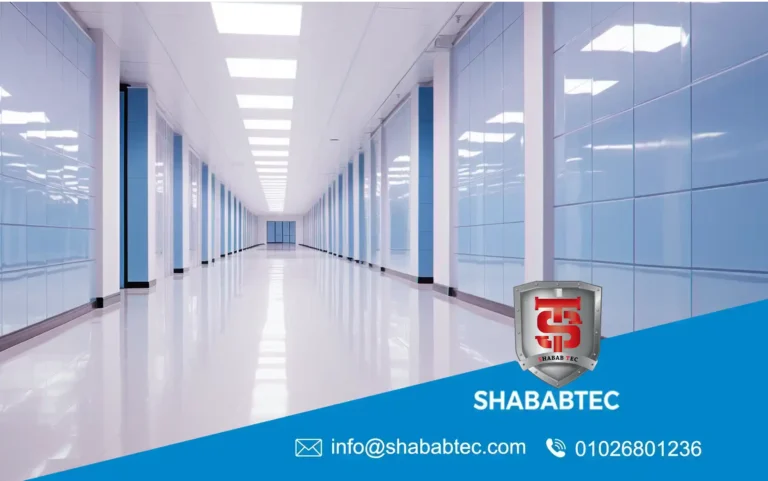
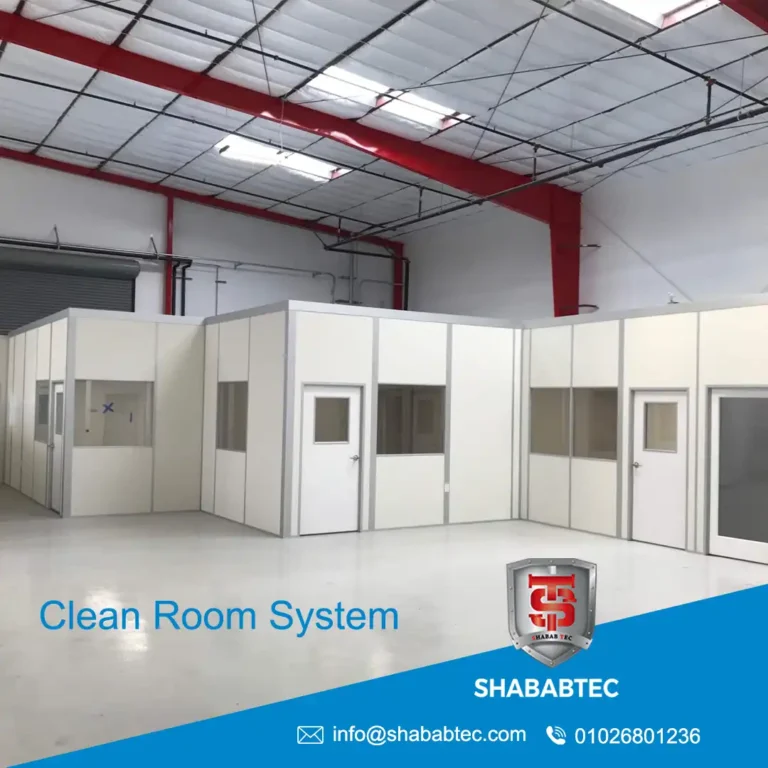
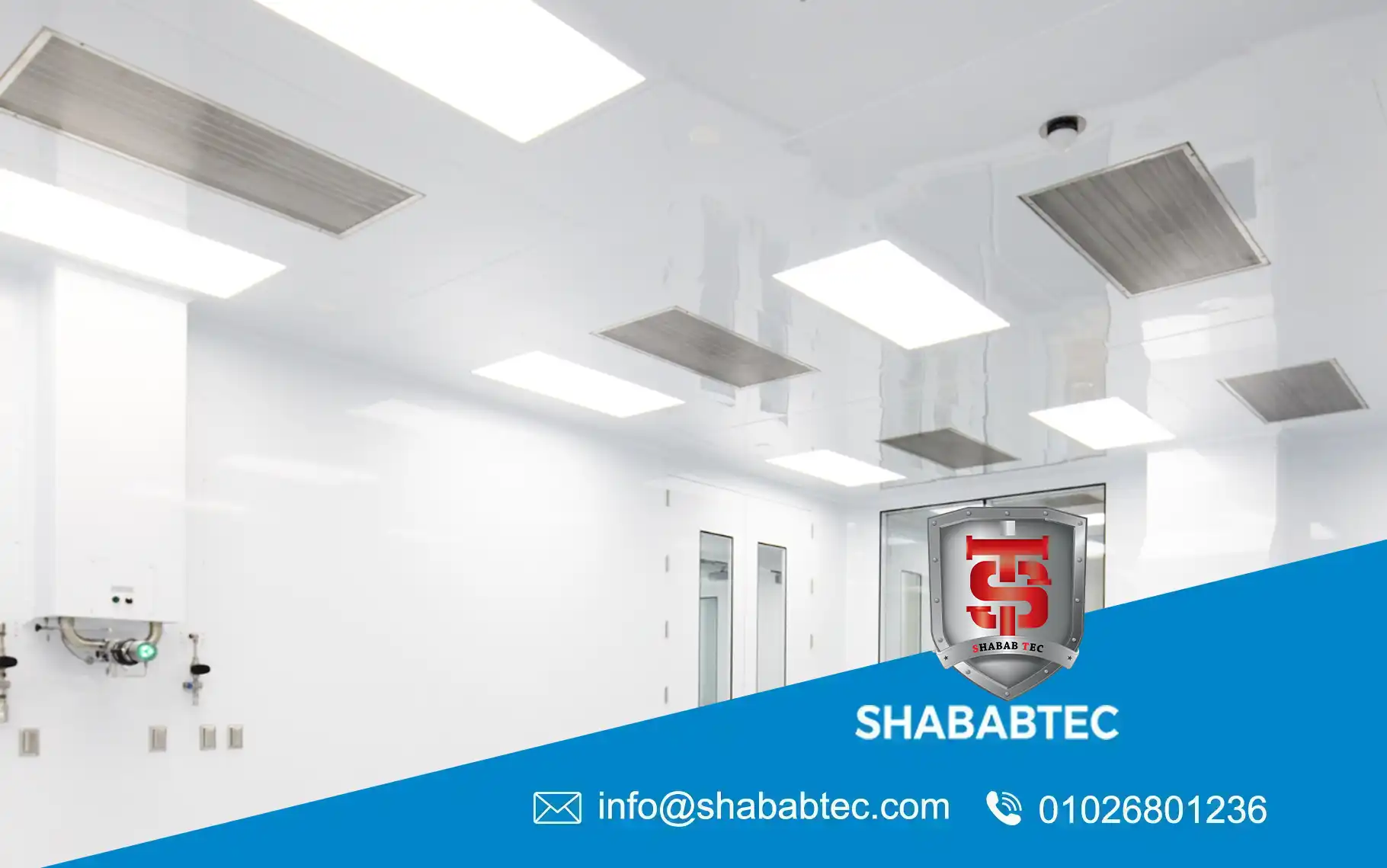
A clean room ceiling system is typically a sealed, modular false ceiling that forms the upper boundary of the controlled envelope.
It is engineered to:
- Maintain an airtight, flush surface with minimal joints and no particle traps
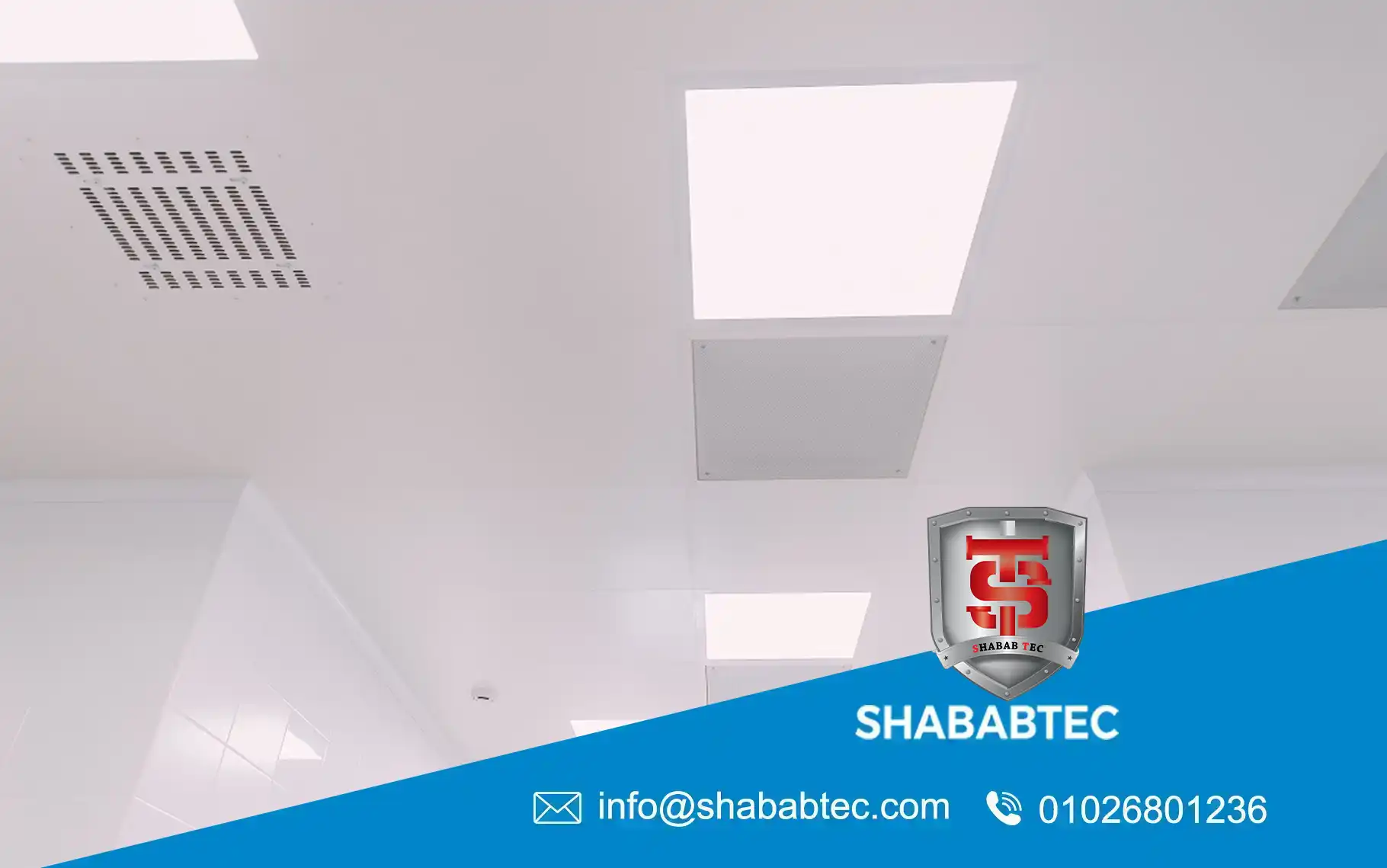
- Integrate HEPA filters, lighting, air terminals, sprinklers, and service penetrations
- Support required loads safely (filters, fixtures, suspended utilities, maintenance access where applicable)
- Enable efficient maintenance and filter replacement without damaging the envelope
Clean Room Ceiling Panel Options
Many searches start with “clean room ceiling panel” because panels define performance and installation speed.
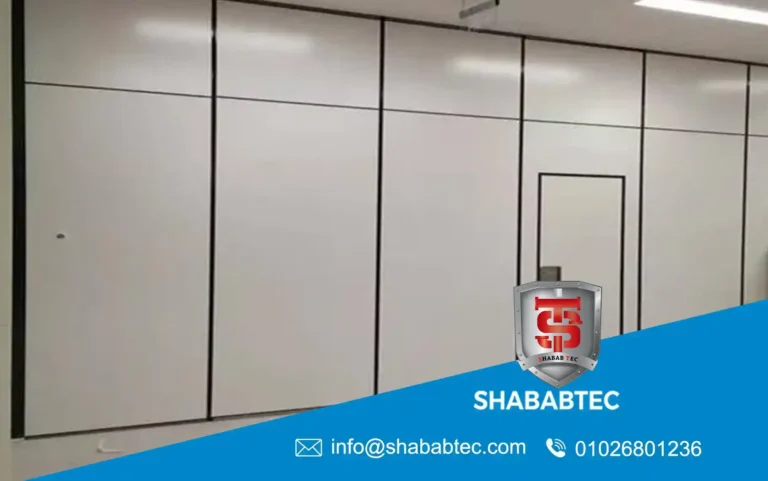
In modular systems, ceiling panels are factory-prepared to align flush with wall panels and accept cut-outs for services.
| Component | Typical Specification | Why It Matters |
|---|---|---|
| Panel thickness | 50 mm | Supports rigidity, flush alignment, and stable long-term performance |
| Skin material | Pre-painted steel or Stainless Steel 304 | Controls chemical resistance, corrosion performance, and cleanability |
| Core material | PU (≈40 kg/m³) or EPS (≈35 kg/m³) | Affects insulation, weight, and mechanical behavior |
| Service cut-outs | Factory-prepared for HEPA, lights, sprinklers, utilities | Reduces site modifications and leakage risk |
| Interface detailing | Flush wall-to-ceiling connections + sealed transitions | Prevents gaps/ledges that become particle traps and audit findings |
Materials Used in Cleanroom Ceilings What to Evaluate
Material selection should match the facility’s cleaning regime, chemical exposure, and compliance expectations.
Two decisions usually drive ceiling performance:
- Skins: pre-painted steel vs SS304 (stainless is preferred for higher chemical exposure and frequent cleaning)
- Cores: PU vs EPS (PU often provides better insulation and mechanical strength; EPS is lighter and more cost-effective)
High-Load Ceiling Design When “Standard” Is Not Enough
Cleanroom ceilings often carry loads beyond panels:
HEPA housings, lighting systems, air terminals, suspended utilities, and sometimes access requirements for maintenance.
A high-load ceiling system should be engineered per project rather than selected as a generic specification.
Common Load Scenarios
- HEPA filters + terminal housings distributed across the grid
- Lighting fixtures and emergency lighting zones
- Suspended service supports (as permitted by the design)
- Maintenance access strategy (access panels vs controlled entry planning)
Ceiling Coverage in a Cleanroom What It Means?
“Ceiling coverage” usually refers to the usable ceiling area available to host cleanroom services (HEPA, lights, air terminals)
while maintaining a sealed, flush envelope. It is not just a % number—coverage must be coordinated with airflow design,
equipment layout, and access requirements.
How to Calculate Ceiling Area (m²) and Volume (L × W × H)
Cleanroom ceiling layouts begin with basic measurement accuracy, then evolve into service zoning and grid coordination.
Ceiling Area Formula
- Ceiling area (m²): Area = Length (m) × Width (m)
- Room volume: Volume = L × W × H
Example (Practical)
- Room length = 6 m, width = 4 m → Ceiling area = 6 × 4 = 24 m²
- If height = 3 m → Volume = 6 × 4 × 3 = 72 m³
How to Measure a Room Ceiling Correctly
- Measure length and width at multiple points (walls are not always perfectly straight)
- Confirm squareness using diagonal checks
- Apply the 3/4/5 rule to verify right angles during grid installation
The 3/4/5 Rule for Squaring
The 3-4-5 rule verifies a right angle:
if one side is 3 units and the other is 4 units, the diagonal should be 5 units.
This helps ensure your ceiling grid and wall lines are square—critical for flush panel alignment and airtight joints.
How to Decide Ceiling Height in Cleanroom Projects
Ceiling height is an engineered decision, usually driven by:
- Airflow strategy (supply/return placement and pressure zoning stability)
- Equipment clearance and service routing
- Lighting distribution and maintenance access planning
- Integration with wall system and load paths
ISO Guidelines for Clean Rooms: Where Ceiling Design Fits
ISO cleanroom compliance is typically aligned with the ISO 14644 series (classification and testing),
while GMP facilities also require practical cleanability, inspectability, and documentation readiness.
Ceiling design contributes by minimizing joints, preventing hidden traps, and enabling stable airflow performance.
Common Problems in Clean Room Ceiling Projects
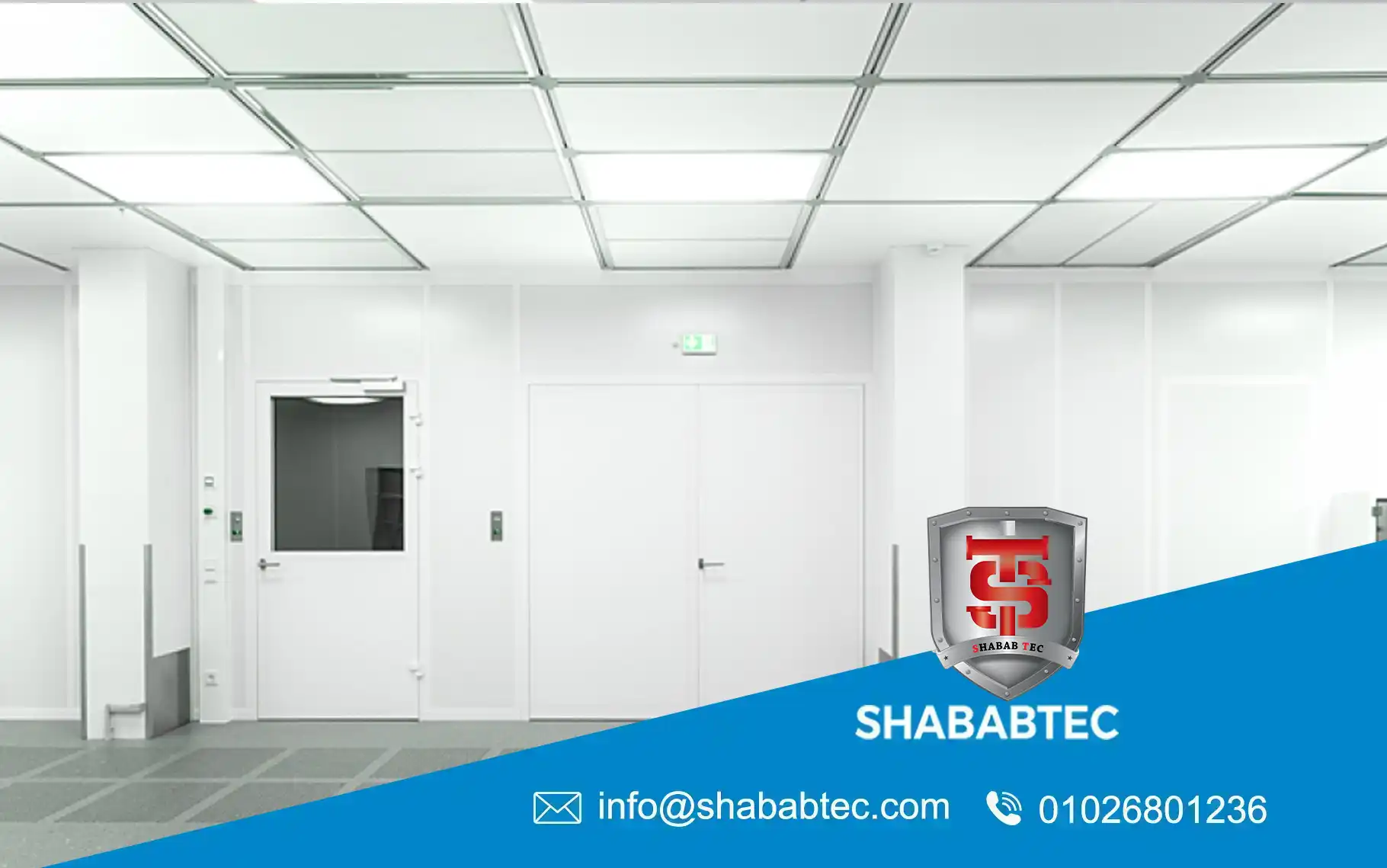
- Misaligned grid + panels: causes gaps and leakage paths → solved by engineered modular alignment
- Weak load design: deformation over time → solved by high-load engineering based on actual equipment
- Too many site modifications: increases contamination risk → solved by factory-prepared cut-outs
- Poor wall-to-ceiling interface: ledges and particle traps → solved by sealed, flush transition profiles
Why Shababtec Reduces Project Risk
- Single responsibility across engineering, production, and execution
- Factory-controlled panel quality and tolerances
- Faster installation timelines with fewer site errors
- Integrated design between walls, ceilings, and services
Related Internal Links (Add These at the Bottom of the Page)
Search For
- Clean room ceiling panel
- Clean room design
- Clean room partition
- Clean room contractors
- Cleanroom engineering design
- Clean room manufacturers in USA
FAQs
- What is the ceiling coverage for a cleanroom?
Ceiling coverage refers to the usable ceiling area available for HEPA, lighting, and services while keeping a sealed, flush envelope. It must be coordinated with airflow design and maintenance strategy. - What is an ISO 7 clean room?
ISO 7 is a cleanroom classification defined by ISO 14644-1 describing maximum allowable airborne particle concentrations at specific particle sizes. - What are the materials used in cleanroom ceiling?
Common materials include pre-painted steel or stainless steel 304 skins with PU or EPS core panels, selected based on cleaning chemicals, frequency, and load requirements. - Which design is appropriate for a room ceiling?
For cleanrooms: a modular false ceiling with sealed joints, flush surfaces, and engineered cut-outs for HEPA filters, lights, and utilities. - How to calculate ceiling space?
Measure room length and width, then multiply: Area = L × W. Sum areas for multiple rooms. - What are the ISO guidelines for clean rooms?
They are defined by the ISO 14644 series, covering classification and testing. GMP projects also require cleanability, inspectability, and documentation readiness. - What is the ceiling formula?
Ceiling area = L × W. Room volume = L × W × H. - What is the size of a standard ceiling?
There is no single standard size; for modular systems, panel module sizes and grid selection are engineered to match room layout and services. - What is the 3/4/5 rule for squaring?
If sides measure 3 and 4 units, the diagonal should be 5 units—used to confirm right angles when setting out walls and ceiling grids. - How to measure a room ceiling?
Measure length and width at multiple points, verify squareness with diagonals (or 3-4-5), then calculate area as L × W. - How to decide ceiling height?
Based on airflow design, equipment clearance, services routing, lighting needs, and maintenance access—engineered for stable cleanroom operation. - What is the concept of ceiling?
The ceiling is the upper interior surface. In cleanrooms, it’s an engineered barrier supporting filtration, lighting, airflow, and airtightness. - What size ceiling for a room?
The ceiling size equals the room footprint: L × W. Cleanroom layouts also consider panel modules and service cut-outs. - What is l * w * h?
It calculates volume. In cleanrooms, volume supports airflow and air-change calculations. - How to calculate ceiling m2?
Convert measurements to meters, then multiply: m² = L × W (e.g., 6 m × 4 m = 24 m²).