
Integrated Industrial Solutions for Your Facility
Engineering, fabrication, and turnkey execution of
Clean Rooms, Processing Systems, RO Units, CIP/SIP Systems,
and Sanitary Stainless Steel Equipment.
Free Engineering Consultation
PHARMACEUTICAL CLEANING & HYGIENIC PROCESS SYSTEMS
CIP & SIP Systems for Pharmaceutical Processing
Cleaning and sterilization engineering integrated with process vessels, sanitary piping, pumps, valves, utilities and hygienic production equipment.
ShababTec develops CIP/SIP requirements around the actual equipment being cleaned, product residue, cleaning circuits, available utilities, drainage, facility layout and required operating process.
Cleaning-Circuit Engineering
Sanitary Process Integration
Testing & Commissioning
Documentation Support
PROCESS DEFINITION
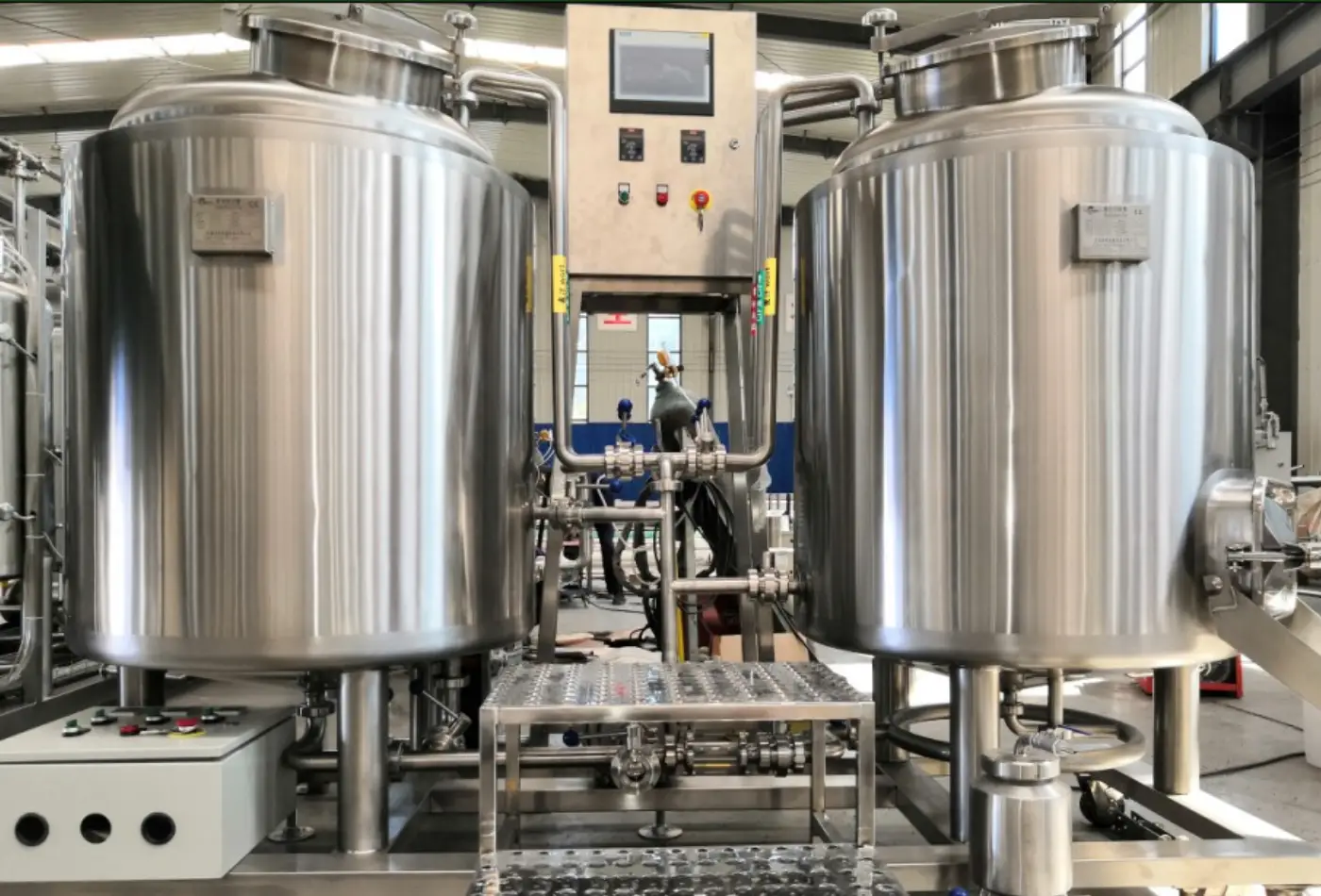
CIP Cleans. SIP Sterilizes.
The two processes have different objectives and should be defined separately before the equipment and cycle architecture are selected.
Controlled Cleaning Without Routine Full Dismantling
CIP circulates water and appropriate cleaning media through product-contact equipment and piping to remove product residue according to a defined cleaning procedure.
Product-residue removal
Internal equipment cleaning
Cleaning-solution circulation
Defined rinse and return conditions
In-Place Sterilization Where the Process Requires It
SIP is a separate process used where cleaned equipment must subsequently be sterilized in place under defined and verified conditions.
Applied after adequate cleaning
Requires suitable equipment and piping
Steam conditions are process-specific
Condensate drainage must be considered
Cleaning is not sterilization.
A completed CIP cycle does not automatically prove SIP performance,
and steam exposure cannot compensate for inadequate residue removal.
START WITH THE CLEANING TARGET
Engineer the Cleaning Process Before Selecting the Skid
The equipment being cleaned determines the cleaning circuit, hydraulic requirement, access, drainage and process interfaces.
A processing vessel, transfer line, homogenizer and filter do not automatically need the same circulation condition or cleaning method.
ShababTec reviews the product, equipment geometry, facility layout, cleaning access, drainage, piping arrangement and operating requirement before defining the project scope.
FIRST ENGINEERING QUESTION
What exactly must the cleaning cycle clean?
Then define the circuit, media, operating parameters and system architecture.
CIP CYCLE CONCEPT
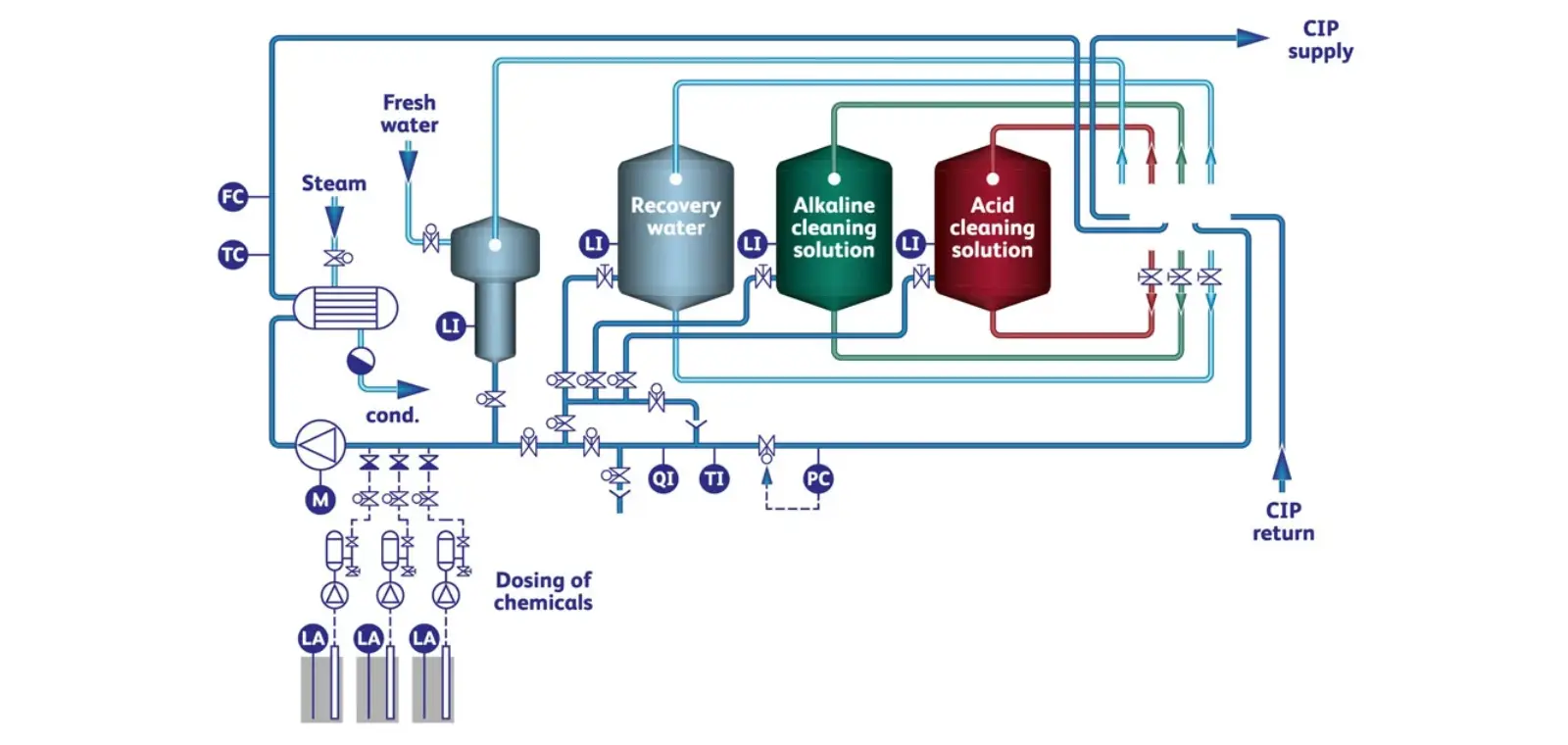
How a Clean-in-Place Cycle Is Structured
The actual sequence is developed for the product and equipment. A typical cleaning concept can include several controlled stages.
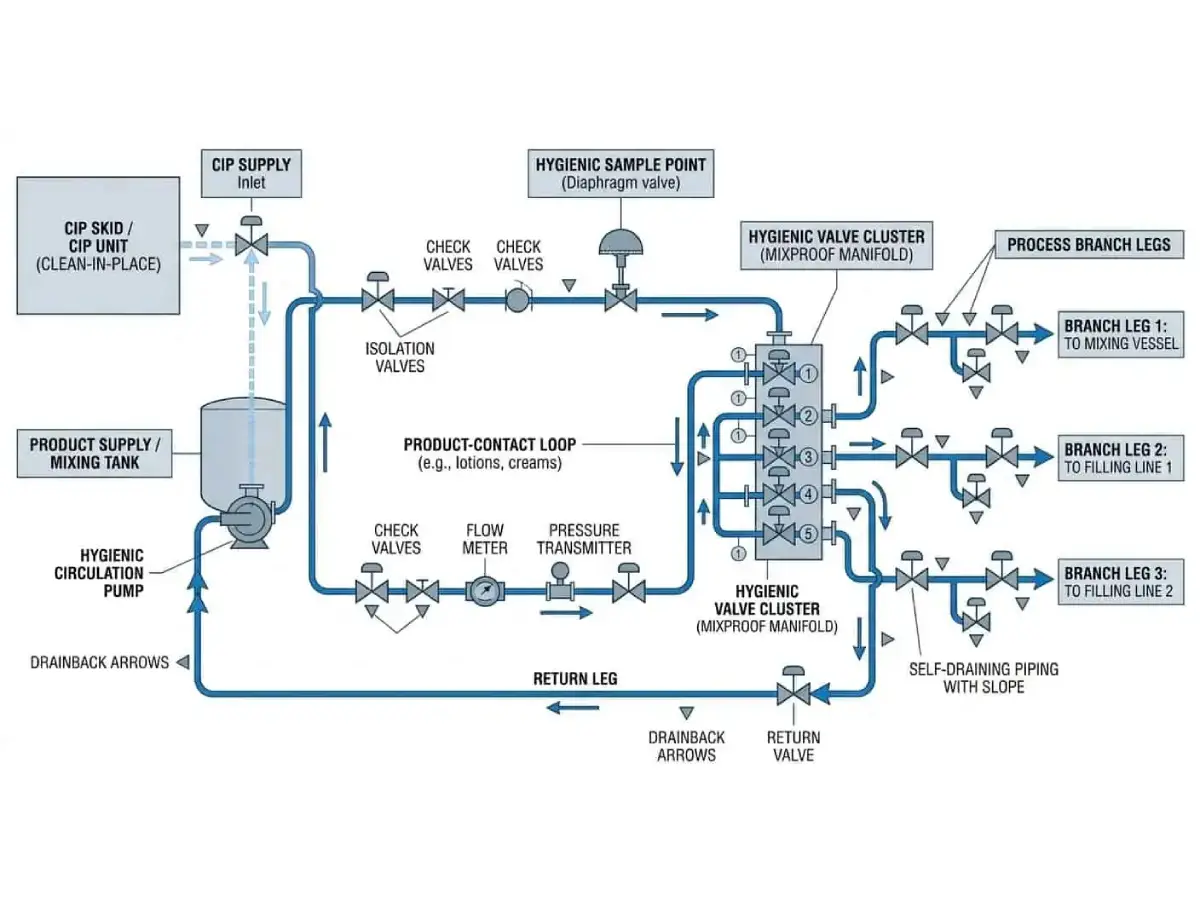
Initial Rinse
Removes loose product residue and prepares surfaces for the main cleaning stage.
Cleaning Circulation
The selected cleaning media circulates through the defined circuit.
Intermediate Stage
Rinsing or another cleaning stage can be included according to the approved cleaning procedure.
Final Rinse
Removes remaining cleaning media according to the required process.
Endpoint / Return Check
The project defines how completion of the cleaning cycle is assessed.
CLEANING PERFORMANCE
What Determines an Effective CIP Cycle?
Effective cleaning depends on several process variables working together with suitable equipment geometry and surface coverage.
Cleaning media must reach the required equipment through an appropriate hydraulic circuit.
Cleaning media should match the actual product residue and materials of construction.
Required temperature is defined by the approved cleaning process.
Each cleaning stage operates for the time required by the process procedure.
Tank cleaning and circuit design should address the required product-contact areas.
Rinse water, cleaning media and condensate must be able to leave the system effectively.
No universal cycle values are published.
Cleaning temperature, chemistry, concentration, flow and duration belong to the actual product, equipment and approved cleaning process.
CONFIGURATION DECISIONS
Mobile vs Fixed. Single-Tank vs Multi-Tank.
These are process-architecture choices rather than simple equipment upgrades.
Flexible Cleaning Between Selected Equipment
Can be evaluated where a facility has a limited number of cleaning points or requires a skid that can serve more than one compatible connection location.
Final availability and architecture are project-specific.Permanent Integration with Defined Circuits
Can suit facilities with frequent cleaning, dedicated routes or greater integration with valves, equipment and controls.
Final availability and architecture are project-specific.Lower Equipment Complexity
Can reduce skid footprint and tank count where cleaning media can be prepared and managed sequentially.
Cycle and media handling must be reviewed for the application.Greater Separation of Cleaning Media
Can support more complex solution preparation, sequencing or recovery strategies at the cost of additional piping, valves, space and controls.
Final tank arrangement must be confirmed during engineering.
Selection depends on:
Circuits
Cleaning Frequency
Utilities
Available Space
Downtime
Automation
Review Your CIP Architecture
PROCESS EQUIPMENT INTEGRATION
Equipment That Can Form Part of a CIP/SIP Circuit
Cleaning requirements should be coordinated with the equipment geometry and the complete hygienic process route.
01
Processing & Mixing Vessels
Tank internals, agitators, outlets, drainage and cleaning
coverage affect the circuit.
02
Vacuum Homogenizers & Emulsifiers
Complex product-contact equipment requires careful cleaning-route review.
03
Sanitary Process Piping
Pipe routing, branches, valves and return paths influence cleanability.
04
Pumps & Transfer Lines
Product-transfer equipment can be coordinated with the selected cleaning circuit.
05
Sanitary Stainless-Steel Filters
Housing, internal screen, drainage and access should be considered.
06
Custom Stainless-Steel Equipment
Cleaning access and drainage can be considered from the fabrication stage.
CIP CIRCUIT ENGINEERING
Supply, Return, Drainage & Cleanability
A good CIP skid cannot correct a poorly designed cleaning circuit.
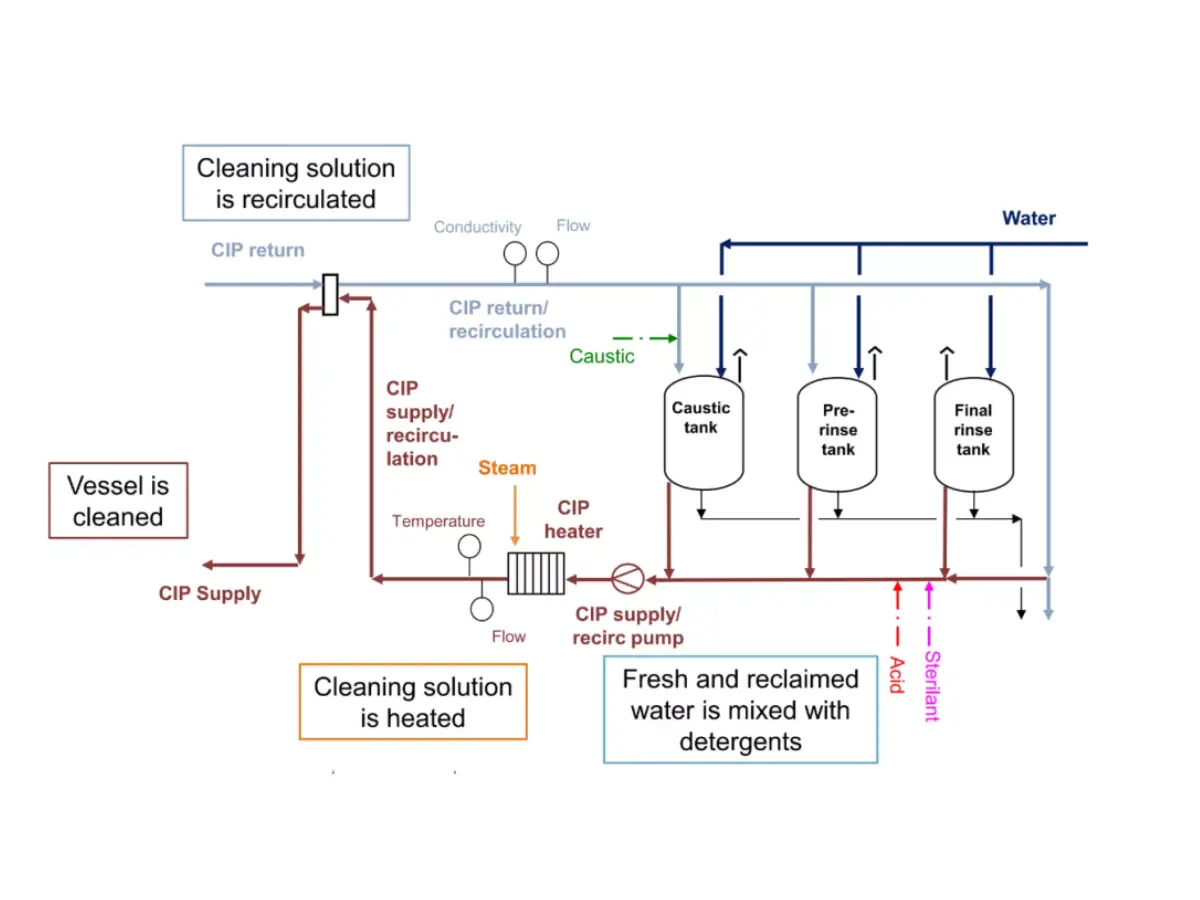
Cleaning media must reach the target surfaces and return through an appropriate process route. Pipe sizing, low points, valves, equipment geometry and drainage all influence the practical result.
Supply route to the cleaning target
Return route from the cleaned equipment
Low points and effective drainage
Valve routing and circuit isolation
Tank-cleaning device positioning
Maintenance and inspection access
STERILIZATION-IN-PLACE
When Does the Process Require SIP?
SIP should be specified where the production process requires cleaned equipment to undergo an in-place sterilization process.
The system should complete the required cleaning process before sterilization begins.
Steam must reach the required parts of equipment and piping according to the approved process.
The process design should address trapped air where it can interfere with effective steam exposure.
Condensate must be able to leave the system through appropriate drainage and steam-trap arrangements.
Temperature, pressure and time requirements are defined by the approved sterilization process.
Cooling, drainage and process readiness should follow the defined operating procedure.
No fixed SIP temperature or exposure time is claimed.
These values belong to the specific equipment, sterilization strategy and validated process requirements.
INSTRUMENTATION & CONTROL
What Should the CIP/SIP System Monitor?
Monitoring requirements should follow the cleaning and sterilization process rather than a generic instrument list.
Can be used to confirm the required circulation condition through the selected cleaning route.
Used where cleaning or sterilization stages require monitored thermal conditions.
Cleaning concentration or rinse return can be monitored with an appropriate project-specific method.
Relevant where equipment, pumps, steam or process circuits require pressure monitoring.
Can support solution preparation and operating sequences where CIP tanks form part of the architecture.
Cleaning and SIP stages require defined timing according to the approved process recipe.
Automated systems may need confirmation that the correct cleaning route has been selected.
Documentation and data requirements should be defined according to the project and validation strategy.
Instrumentation is project-specific.
Individual sensors, PLC/HMI functions, alarms, recipes and
data-recording requirements must be confirmed in the technical proposal.
COMMISSIONING & DOCUMENTATION
Validation Starts with Defined Acceptance Criteria
Automation alone does not validate a cleaning or sterilization process. The project first needs defined operating parameters, required results and acceptance criteria.
ShababTec's wider project scope includes testing, commissioning, documentation support and validation assistance. The company profile also lists IQ, OQ and DQ documentation among its engineering capabilities.
The exact CIP/SIP documentation package should therefore be agreed as part of the project scope before execution.
Requirement & system information
Engineering documentation
Testing & commissioning records
DQ / IQ / OQ support according to scope
Professional project handover
APPLICATIONS
CIP/SIP for Hygienic & Controlled Production
Pharmaceutical Manufacturing
Cleaning and SIP integration for suitable vessels, tanks, piping and hygienic process equipment.
Cosmetics & Personal Care
Repeatable cleaning of mixing and transfer systems handling creams, gels, lotions and liquid products.
Food & Beverage
Cleaning circuits for sanitary tanks, pipelines and suitable liquid-processing systems.
Biotechnology & Laboratories
Hygienic process and utility integration according to the facility's cleaning and sterilization requirements.
SHABABTEC PROJECT EXECUTION
From Requirement Study to Commissioning
Requirement Study
Review product, cleaning targets, equipment, facility, utilities and operating objectives.
Engineering Design
Define cleaning circuits, piping, drainage, utilities and required interfaces.
Manufacturing & Fabrication
Prepare the approved tanks, skids, piping and custom stainless-steel components.
Installation
Coordinate equipment, process piping, utilities and hygienic site connections.
Testing & Commissioning
Check system routing, operation and readiness before handover.
Documentation & Support
Provide agreed documentation, validation support and after-sales technical assistance.
ENGINEERING RFQ CHECKLIST
What to Send for a CIP/SIP System Quotation
A useful quotation starts with the cleaning target and process, not only the requested number of CIP tanks.
Cleaning Targets
Tanks, vessels, piping, pumps, filters and other equipment.
Product / Residue
Identify the material that remains after production.
Number of Circuits
State how many separate cleaning routes are required.
Equipment Data
Provide vessel sizes, drawings and available equipment details.
Pipeline Data
Share line sizes, approximate route lengths and layout.
CIP Requirement
Provide the current or required cleaning procedure where available.
SIP Requirement
State whether in-place sterilization is required.
Utilities
Water, heating, steam, electricity, air and relevant services.
Automation
State required operator control, recipes and monitoring needs.
Documentation
State commissioning, DQ, IQ, OQ or validation-support requirements.
DON'T HAVE A CIP DESIGN YET?
Send Your CIP/SIP Requirements
Start with the Equipment List & Facility Layout
ShababTec can review the process equipment, cleaning targets, utilities and production requirements before the final CIP/SIP architecture is defined.
FAQ
Pharmaceutical CIP & SIP System FAQ
What is a Clean-in-Place system?
A Clean-in-Place system circulates water and appropriate cleaning media through internal product-contact equipment and piping so the required surfaces can be cleaned without routine full dismantling of the process system.
What is the difference between CIP and SIP?
CIP is a cleaning process used to remove product residues and cleaning contaminants. SIP is a separate in-place sterilization process used where the cleaned equipment must subsequently achieve the required sterilization condition.
Does every pharmaceutical process require SIP?
No. SIP requirements depend on the product, production process, hygiene strategy and required microbiological or sterile state. The requirement should be defined by the facility and process specification.
Can CIP be integrated with mixing vessels and homogenizers?
Yes. ShababTec's hygienic process scope includes process vessels, mixing equipment, piping and CIP/SIP integration. The cleaning circuit must be designed around the actual equipment geometry, product-contact surfaces, drainage and cleaning requirements.
Should a CIP system be mobile or fixed?
The choice depends on the number of cleaning circuits, cleaning frequency, available space, required integration, utilities and operating philosophy. The final ShababTec configuration is defined according to the project.
Should a CIP skid use one tank or multiple tanks?
The correct architecture depends on the cleaning media, required cycle, solution preparation and recovery strategy, available footprint, cleaning frequency and operating requirements. A larger tank count is not automatically a better design.
What determines the CIP cycle parameters?
Important factors include the product residue, cleaning chemistry, equipment geometry, flow and circulation requirements, temperature, contact time, surface coverage, drainage and required acceptance criteria.
What temperature and time does ShababTec use for SIP?
ShababTec does not publish one universal SIP temperature or exposure time. The required conditions must be established for the actual equipment, sterilization strategy and approved process.
Does ShababTec support CIP/SIP commissioning and documentation?
Yes. ShababTec's published project scope includes testing, commissioning, documentation support and validation assistance. The exact documentation and qualification-support package is defined according to the agreed project scope.
What information should I send for a CIP/SIP quotation?
Send the equipment to be cleaned, product or residue, number of cleaning circuits, vessel and pipeline information, required cleaning process, SIP requirement, available utilities, automation needs and documentation or validation requirements.
ENGINEER THE CLEANING PROCESS FIRST
Define the CIP/SIP System Around Your Actual Equipment
Share the process equipment, product residues, cleaning circuits, utilities, SIP requirement and required documentation. ShababTec can review the hygienic process and prepare the appropriate engineering scope and quotation.
Request a CIP/SIP Engineering Review
Send Your Cleaning Requirements
ShababTec • Egypt & Middle East